Healthcare Software Development: Cost, Timeline and HIPAA Guide
- August 4, 2026
- Posted by: Rahul Varshneya
- Category: Custom Healthcare Software Development

Healthcare software development is the discipline of designing, building, validating, and maintaining software that handles protected health information and supports clinical or administrative care delivery. It covers electronic health records, telehealth platforms, remote patient monitoring tools, payer systems, pharmaceutical research applications, and the integration work that moves data between them. What separates it from general software work is that regulatory compliance, interoperability, and patient safety are architectural inputs rather than features bolted on before launch.
Arkenea has worked exclusively in healthcare since 2011, and in that time the pattern has stayed consistent: the projects that succeed are the ones where compliance and integration decisions were made in week two rather than month nine. This guide reflects what we have learned as a custom healthcare software development company across provider, payer, pharma, and startup engagements. Every cost range, timeline, and standard named below comes from either published federal guidance or work we have actually shipped.
You will find answers here to the questions that decide a project rather than the ones that fill a brochure. That means what to build, whether to buy instead, what it costs, how long it takes, which regulatory deadlines land in 2026 and 2027, and how to keep protected health information safe by design. Where a point can be grounded in an engagement, this guide points to the case study instead of speaking in the abstract.
What is healthcare software development?
Healthcare software development is the process of creating digital products that support diagnosis, treatment, care coordination, reimbursement, research, and patient engagement, under regulatory constraints that ordinary software never faces. The output ranges from a single medication reminder app to an enterprise platform tying together scheduling, documentation, prescribing, and claims. The defining constraint is that the software touches protected health information, which makes privacy, security, and auditability structural requirements.
People use the terms healthcare software and medical software interchangeably, but the distinction changes your obligations. Medical software influences clinical decisions or functions as a medical device, which can place it under Food and Drug Administration authority and the IEC 62304 software lifecycle standard. Healthcare software is the broader category that includes operational tools with no diagnostic role, such as practice management, scheduling, or revenue cycle systems.
Knowing which bucket your product falls into on day one changes your compliance obligations, your documentation burden, and your timeline by months. A scheduling tool and a triage algorithm can look similar in a wireframe and have completely different regulatory paths. This classification is the first question we ask in discovery, before anyone opens a design file.
The demand behind this work is measurable rather than speculative. The U.S. healthcare IT software market was valued at USD 166.83 billion in 2024 and is projected to reach USD 388.99 billion by 2030 at a compound annual growth rate of 15.46 percent, according to Grand View Research.
Adoption of foundational systems is already near saturation, with 95 percent of office based physicians using an electronic health record and 91 percent using a certified system, per the Office of the National Coordinator for Health Information Technology. The opportunity has shifted from first adoption toward replacing tools clinicians dislike and connecting systems that do not talk to each other.
What makes software development in healthcare different from other industries?
Software development in healthcare differs from general software work in five structural ways: the data is federally protected, the standards are mandatory rather than optional, defects can reach patient safety, buyers demand documented evidence, and integration with incumbent systems is usually a precondition for sale. Each of these changes engineering practice rather than just adding paperwork. Teams that treat healthcare as ordinary software with a compliance review at the end discover the difference during a security questionnaire or a failed hospital pilot.
Protected health information carries statutory obligations under the HIPAA Privacy Rule and HIPAA Security Rule, which means access control, encryption, and audit logging are load bearing rather than optional. Interoperability standards such as HL7 v2, HL7 FHIR R4, and DICOM are how your product exchanges data with the systems around it, and a product that cannot exchange data has limited commercial value. Enterprise healthcare buyers routinely ask for SOC 2 Type II evidence, penetration test results, and a signed Business Associate Agreement before a pilot begins.
The patient safety dimension raises the testing bar in a way that surprises teams from consumer software. A defect in a retail checkout costs revenue, while a defect in a medication list or a dosing calculation can cause harm. That is why regulated healthcare builds carry formal verification and validation records rather than only a passing test suite.
One assumption worth correcting: healthcare software is not slower to build because engineers work less efficiently. It is slower because integration negotiation, validation evidence, and security review are genuine work items that generic estimates leave out. Budgeting for them honestly produces a schedule you can hold rather than one you keep revising.
What types of healthcare software do organizations actually build?
Most healthcare products fall into a recognizable set of categories, and naming the right one early keeps scope honest. The table below groups the common types by primary user and core purpose. Many products in practice combine two or three of these rather than sitting neatly in one row.
| Software type | Primary users | Core purpose | Typical regulatory weight |
|---|---|---|---|
| Electronic health record (EHR) and EMR | Clinicians, nurses, front desk | Capture and retrieve charts, notes, orders, results | High, often ONC certification |
| Practice management | Administrative staff | Scheduling, registration, eligibility, front office workflow | Moderate, HIPAA only |
| Telehealth and virtual care | Patients and providers | Video visits, messaging, remote consultation | Moderate, HIPAA plus state licensure rules |
| Remote patient monitoring (RPM) | Care teams and patients | Collect vitals and device data between visits | Moderate to high, device dependent |
| Revenue cycle management (RCM) | Billing teams | Coding, claims, denials, collections | Moderate, HIPAA and X12 transaction rules |
| Utilization management and claims review | Payers, nurses, medical directors | Prior authorization, medical necessity review, appeals | High, CMS turnaround rules apply |
| Medical imaging and PACS | Radiologists | Store, retrieve, and read diagnostic images | High, DICOM plus possible FDA scope |
| Laboratory information systems (LIS) | Lab technicians | Order, track, and report lab results | High, CLIA and LOINC coding |
| Clinical decision support (CDSS) | Clinicians | Alerts, guidelines, and risk scores at the point of care | High, frequently FDA regulated |
| Clinical trial and pharma systems | Sponsors, sites, coordinators | Protocol execution, electronic consent, safety reporting | High, GxP and 21 CFR Part 11 |
| Patient engagement and mHealth | Patients | Portals, reminders, education, self management | Lower, HIPAA plus accessibility |
| Analytics and population health | Administrators, quality teams | Reporting, risk stratification, outcome tracking | Moderate, identifier removal rules apply |
Clinical systems such as EHRs, imaging, and decision support carry the highest stakes because they sit inside care delivery. Operational systems such as practice management and revenue cycle carry lower clinical risk but demand deep integration to be useful at all. Patient facing apps live or die on usability, since a patient who finds the interface confusing simply stops opening it.
Which type should a first product be?
Most first products should be a narrow workflow tool that connects to an existing record system, not a new EHR. Building a net new EHR is among the most expensive undertakings in this field because it must handle charting, orders, results, billing hooks, and certified interoperability at once. A focused product such as a specialty documentation aid or a monitoring app reaches market faster and validates demand before you commit to a platform.
Founders often arrive convinced they need the platform because that is what the eventual business looks like. The counterargument is not that platforms are wrong, but that sequencing them after evidence is cheaper than sequencing them before it. We routinely steer early stage clients toward the smaller footprint first, then expand once usage confirms the direction.
Should you build custom software or buy off the shelf?
Buy off the shelf when the process is generic and not a source of competitive advantage, and build custom when the workflow is where your organization differs or where the software itself is the product you will commercialize. That single rule resolves most build versus buy debates before they turn into committee exercises. The honest framing is a set of tradeoffs rather than a verdict that custom always wins.
| Factor | Off the shelf | Custom build |
|---|---|---|
| Upfront cost | Low, subscription based | Higher, project based |
| Time to launch | Days to weeks | Months |
| Workflow fit | You adapt to the tool | The tool adapts to you |
| Cost at scale | Rises with seats and usage | Flat after build, plus maintenance |
| Differentiation | The same tool your competitors use | A product only you have |
| Control and ownership | Vendor sets the roadmap | You own the code and priorities |
| Compliance responsibility | Shared, vendor holds certifications | Yours, with full control of controls |
| Exit cost | Data export limits and lock in | You hold the repository and data |
How do you model total cost of ownership over five years?
Compare the two options on five year total cost of ownership rather than first year price, because that is where the ranking usually flips. For a subscription product, multiply the per seat price by your projected headcount for each of the five years, then add integration work, configuration consulting, and the internal hours spent working around gaps. For a custom build, take the build cost, add annual maintenance at 15 to 20 percent of the build, then add hosting and any compliance audit fees.
Work a concrete example. A 60 seat clinical team on a platform at USD 250 per seat per month costs USD 180,000 per year, or USD 900,000 over five years before any integration spend. A custom build at USD 220,000 with maintenance at 18 percent runs roughly USD 418,000 over the same period, which changes the conversation entirely.
The comparison flips the other way when headcount is small or the process is genuinely commodity. Ten users on the same subscription cost USD 150,000 over five years, which no custom build will beat. Run the arithmetic with your actual seat count before anyone argues from principle.
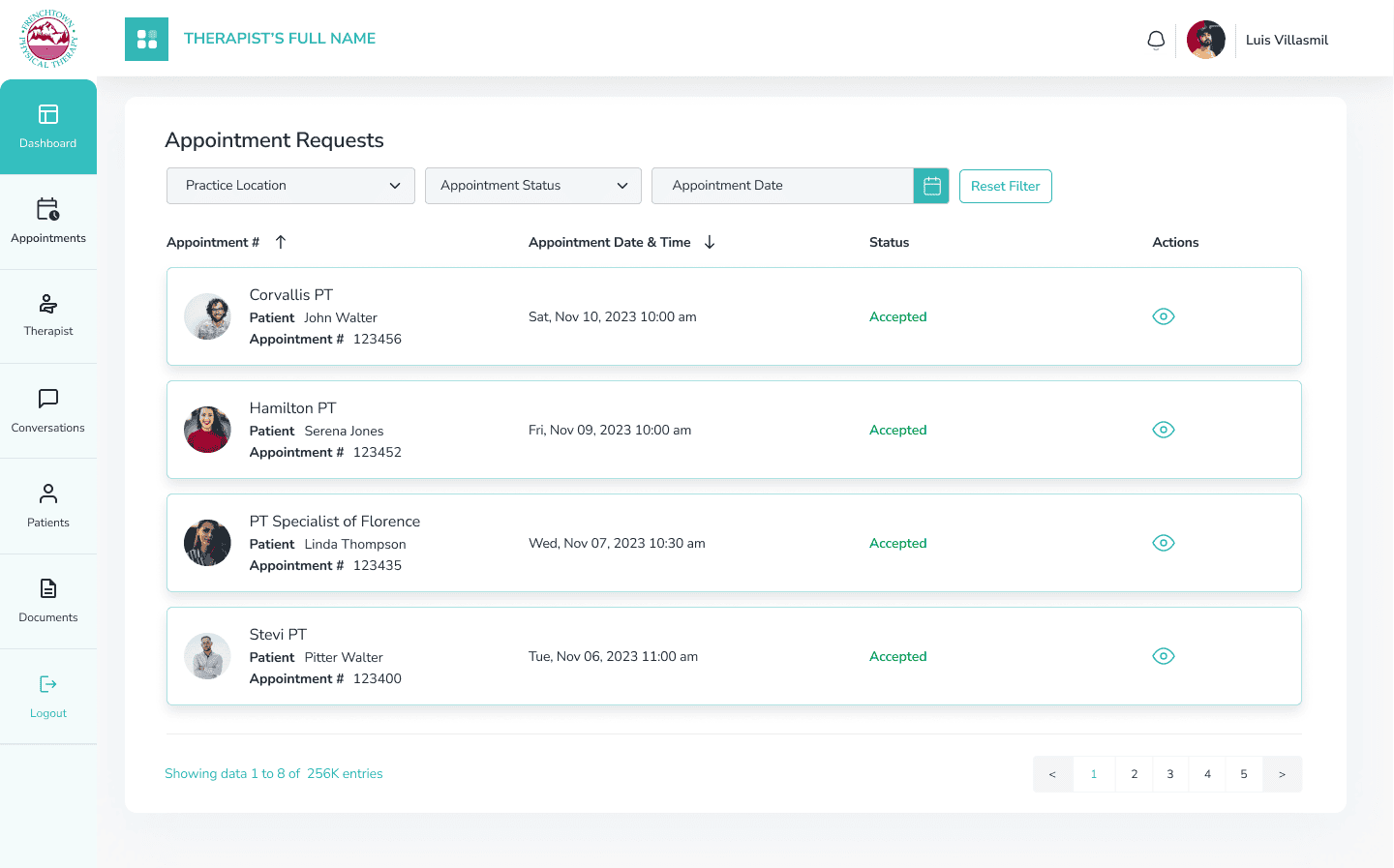
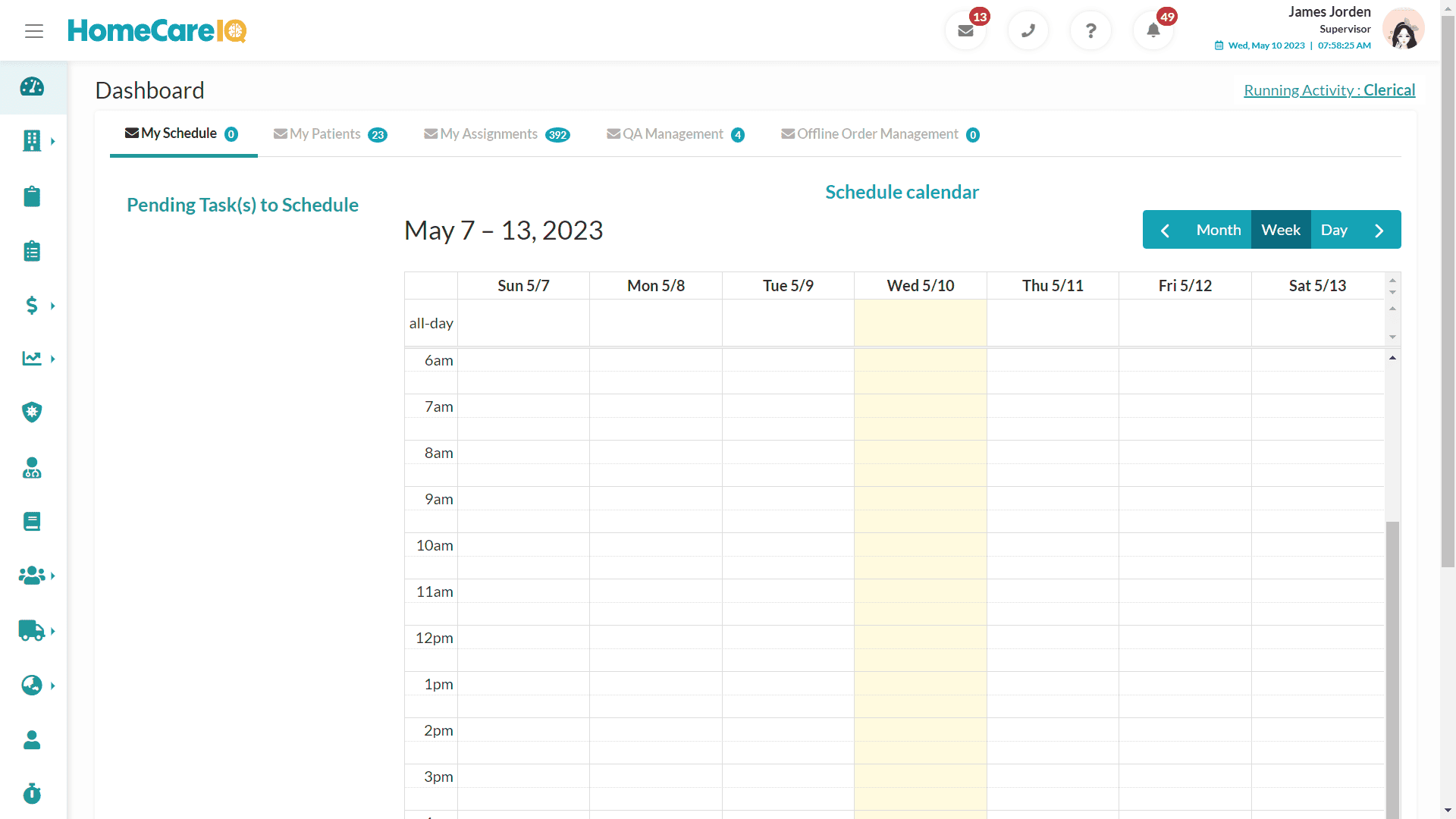
The cost of a poor workflow fit is the line item teams underestimate most. When Hamilton Physical Therapy came to us, they were running eight locations across Montana on an off the shelf EHR with cumbersome workflows that pulled clinicians away from patients. We replaced it with a custom EHR built for their exact workflow that integrated directly with their billing software and cut redundant data entry.
You can read the full account in the Hamilton Physical Therapy EHR case study. The lesson generalizes: the sticker price of a packaged tool ignores the daily tax of a workflow it was never designed for. Multiply a few wasted minutes per encounter across eight locations and the arithmetic stops being close.
What does the healthcare software development process look like step by step?
The healthcare software development process runs through seven stages: discovery and regulatory classification, requirements and architecture, design and prototyping, iterative development, testing and validation, phased deployment, and ongoing maintenance. Each stage exists to retire a specific category of risk. Skipping one rarely saves time, because the risk it was meant to catch resurfaces later at higher cost.
Stage 1: Discovery and regulatory classification
Discovery defines the problem, the users, and the smallest version of the product that proves value, and it is where regulatory classification happens. Whether your software is a medical device changes the documentation, testing, and submission work downstream, so this decision cannot wait. We map the clinical workflow with the people who will use the tool, not only the executives who commissioned it.
A tight discovery produces a scoped backlog and a defensible estimate rather than an optimistic number written to win a deal. Expect discovery on a mid sized healthcare product to take 3 to 6 weeks and to cost between USD 15,000 and USD 40,000. That spend is the cheapest insurance available against a build that drifts.
Stage 2: Requirements and architecture
Architecture is where you decide the data model, the integration points, the hosting strategy, and how protected health information will be isolated, encrypted, and logged. These decisions are expensive to reverse because they propagate into every subsequent module. Compliance belongs in this stage as a design input, not as a review before launch.
Three architectural questions carry disproportionate weight in healthcare. Where does protected health information live and which services can reach it, how is identity established and revoked across roles, and what does the audit trail record so that you can later prove who accessed what. Answering those three well makes the HIPAA Security Rule technical safeguards largely a byproduct of good design.
Stage 3: Design and prototyping
Clinical software fails more often from poor usability than from missing features, so interactive prototypes should be tested with actual clinicians before production code is written. Testing the flow at this point catches confusion while it is still inexpensive to change. For patient facing products, accessibility under WCAG 2.1 AA and plain language matter as much as visual polish.
Ask clinicians to complete a full task under time pressure rather than to review screens in a calm room. A charting flow that reads well in a design review can still fail at 4pm in a busy clinic. Task based testing surfaces that gap while it is still a design decision.
Stage 4: Iterative development
Build in short iterations that each produce something a user can try, with code review, automated testing, and a working increment at the end of each cycle. Agile fits healthcare well because requirements sharpen as clinicians see the software take shape and because regulations shift underneath long projects. Security controls get written as the code is built rather than added in a hardening sprint.
Agile and regulated development are not in conflict, which is a common misconception. IEC 62304 specifies lifecycle activities and records, not a waterfall sequence, so iterative delivery is compatible as long as the required documentation is produced along the way. The discipline is in keeping design history current, not in slowing the cadence.
Stage 5: Testing and validation
Quality assurance in healthcare has to prove safety, not only catch defects. That means functional testing plus security testing, interoperability testing against live standard messages, and, for regulated products, formal verification and validation that documents the software does what it claims. Software meeting the medical device threshold follows the lifecycle expectations in IEC 62304.
Interoperability testing deserves separate budget because integrations fail in ways unit tests never surface. Sending and receiving real HL7 v2 messages or FHIR resources against a partner sandbox exposes the format mismatches and character encoding quirks that only appear with live data. Skipping this is how a product passes internal testing and then breaks the first day it meets a hospital EHR.
Stage 6: Phased deployment and adoption
Launch in healthcare is rarely a single switch, and a phased rollout to one site or one team surfaces practical issues before they reach every user. Training, record migration, and a clear support path decide whether adoption sticks or stalls. A technically sound system that clinicians resist is still a failed project.
Budget 10 to 15 percent of the build for training, migration, and change management. Teams that pour everything into engineering and nothing into rollout produce software that works and nobody uses. Adoption planning is part of the engineering plan, not a marketing afterthought.
Stage 7: Maintenance and iteration
Software in production needs security patching, dependency updates, compliance changes, and refinement based on how people actually use it. Integrated systems release new versions, standards advance, and regulations change, so a healthcare product is never finished. Budgeting for this from the start prevents the slow decay that turns a good launch into a liability.
How long does healthcare software development take?
A focused minimum viable product typically takes 3-6 months, a full featured platform runs 6-12 months, and a product requiring FDA clearance or deep multi system integration commonly extends past 12 months and can reach 24 months. These are ranges rather than promises, because the drivers below move the number substantially. The most common cause of a missed timeline is not slow engineering but scope that was never pinned down during discovery.
| Driver | Typical effect on timeline |
|---|---|
| Number and depth of integrations | Each EHR, lab, pharmacy, or payer connection adds 3 to 8 weeks of build and testing |
| Regulatory pathway | FDA 510(k) clearance commonly adds 6 to 12 months of validation and submission work |
| Data migration | Cleaning and mapping legacy records adds 4 to 12 weeks and is routinely underestimated |
| Number of distinct user roles | Each additional role adds design, permission logic, and test surface |
| Clinical validation needs | Safety critical features require longer test cycles and documented evidence |
| ONC certification | Certification testing for relevant criteria adds months and recurring surveillance |
Integration count predicts schedule better than feature count, and the reason is worth understanding. Connecting to an EHR is a negotiation with another system’s data formats, authentication model, sandbox availability, and quirks, and every endpoint behaves a little differently. A product with three integrations is rarely three times the work of one, because the combinations multiply the testing surface.
Vendor sandbox access is the scheduling variable teams forget. Getting approved for a production connection with a major EHR vendor can take weeks of paperwork that no amount of engineering speed shortens. Start those applications during architecture, not when the code is ready.
How much does custom software development for healthcare cost?
Custom software development for healthcare typically costs USD 40,000 to USD 90,000 for a focused app or portal, USD 100,000 to USD 250,000 for a mid sized platform, and USD 300,000 and up for enterprise or regulated systems. Cost tracks integration depth, number of user roles, and regulatory burden far more closely than it tracks feature count. Treat these as a frame for a scoping conversation rather than a price list.
| Product scope | Typical range | What it includes | Typical duration |
|---|---|---|---|
| Focused app or portal | USD 40,000 to 90,000 | Appointment booking, patient portal, basic mHealth features, one integration | 3-5 months |
| Mid sized platform | USD 100,000 to 250,000 | Custom workflows, several integrations, multiple user roles, reporting | 6-10 months |
| Enterprise or regulated system | USD 300,000 and up | Full EHR, telehealth at scale, payer platforms, FDA regulated products | 12-24 months |
| Annual maintenance | 15 to 20 percent of build | Hosting, patching, compliance updates, enhancements | Ongoing |
What actually drives the number up or down?
Four variables move a healthcare software estimate more than anything else. Integration count and depth come first, because each connection carries its own authentication, mapping, and testing work. Regulatory pathway comes second, since a device classification adds validation documentation that can equal 20 to 30 percent of engineering effort.
Number of distinct user roles comes third, because every role adds permission logic, screens, and test cases that compound. Data migration comes fourth, and it is the one clients most often assume is trivial. Legacy records are rarely clean, and mapping them into a new model without losing clinical meaning is slow, careful work.
Compliance engineering is not a line item you can defer to save money. Encryption, access control, audit logging, and secure key management are foundational, and retrofitting them costs multiples of building them in. When a proposal looks unusually cheap for healthcare, this is usually what was left out.
How do developer rates vary by location?
Engineering rates for healthcare work run roughly USD 25 to USD 50 per hour offshore, USD 50 to USD 90 per hour nearshore, and USD 120 to USD 200 per hour onshore in the United States. Healthcare specialization sits at the upper end of each band because domain fluency is scarcer than general engineering skill. These figures reflect 2026 market observations and move with demand.
The lowest hourly rate rarely produces the lowest project cost, and the reason is specific rather than rhetorical. Teams without healthcare experience spend billable hours learning HIPAA constraints, misinterpreting HL7 v2 segments, and rebuilding architecture that failed a security review. Rework is invisible in a rate card and very visible in a final invoice.
Should you use fixed price or time and materials?
Use fixed price when scope is genuinely well defined and unlikely to change, and use time and materials when requirements will evolve as clinicians engage with the product. Fixed price buys budget certainty at the cost of flexibility, and every change becomes a change order negotiation. Time and materials trades certainty for the ability to adapt without renegotiating a contract.
The pattern that works most reliably is a fixed price discovery phase that produces a scoped estimate, followed by time and materials delivery once the unknowns are smaller. That structure gives you a real number before you commit the full budget. It also gives both sides a clean exit point if discovery reveals the project should not proceed as imagined.
How does HIPAA shape architecture rather than sit on a checklist?
HIPAA shapes the data model, the hosting topology, the identity system, and the audit trail, which means it constrains architecture rather than adding a compliance feature. The HIPAA Security Rule organizes requirements into administrative, physical, and technical safeguards, and the technical safeguards translate directly into engineering work. When compliance is designed in, it becomes nearly invisible in daily operation, and when it is added late, it leaves the gaps that become breaches.
The financial stakes are documented rather than theoretical. Healthcare data breaches cost an average of USD 6.64 million in 2026, making healthcare the costliest industry for the thirteenth consecutive year, according to the IBM Cost of a Data Breach Report. More than 7,400 large healthcare breaches have been reported to the HHS Office for Civil Rights since mandatory reporting began in 2009, affecting over 935 million records, per HIPAA Journal breach statistics.
What does HIPAA look like inside the architecture?
Compliance by design shows up as specific engineering decisions rather than a policy binder. Protected health information is encrypted at rest and in transit, and access is granted by role so each user sees only what the job requires. Every read and write to sensitive data is written to an audit trail that cannot be quietly altered, which is what lets an organization later prove who touched what.
Beyond those basics, four patterns show up in every compliant system we build. Session management with automatic timeout and reauthentication, key management separated from application code, minimum necessary data returned by every API rather than whole records, and environment separation so that production data never reaches a development database. These are the load bearing walls, not refinements.
Audit logging deserves specific attention because it is where teams cut corners. A log that records only successful actions is not an audit trail, since denied access attempts are exactly what an investigation needs. Immutability matters too: if an administrator can edit the log, the log proves nothing.
Which HIPAA assumptions cost teams the most money?
Four assumptions come up in almost every first engagement, and each one is wrong in a way that gets expensive. Naming them plainly is more useful than repeating that compliance is important.
- There is no such thing as HIPAA certification issued by the federal government. Vendors may hold SOC 2 Type II or HITRUST attestations, and those are useful evidence, but no agency certifies an application as HIPAA compliant. Compliance is a demonstrated state, not a badge you purchase.
- Using a cloud provider that supports HIPAA workloads does not make your application compliant. The provider secures the infrastructure, and you remain responsible for how your software stores, transmits, and controls access to protected health information. The shared responsibility model puts the application layer squarely on your side of the line.
- A Business Associate Agreement is required with every vendor that touches protected health information, including analytics, logging, email, and support tools. Skipping one leaves you exposed no matter how strong the technical controls are. Subcontractors of your business associates need equivalent agreements as well.
- Removing names and dates of birth is not de identification under HIPAA. The Privacy Rule specifies either the Safe Harbor method covering 18 identifier categories or an expert determination, and partial removal satisfies neither. Analytics products built on incorrectly stripped data carry real liability.
Is the HIPAA Security Rule changing?
A significant Security Rule update is proposed but not yet final, and planning should account for it without assuming a date. The HHS Office for Civil Rights issued a notice of proposed rulemaking on December 27, 2024 that would remove the distinction between required and addressable specifications, mandate encryption of electronic protected health information at rest and in transit, require multi factor authentication, require vulnerability scanning at least every six months, and require penetration testing at least once every 12 months, as set out in the HHS fact sheet on the proposed rule. The comment period closed in March 2025 and drew more than 4,000 comments, and as of August 2026 no final rule has been issued. The current Security Rule remains in effect while rulemaking continues.
The practical advice is to build to the proposed requirements now even though they are not binding yet. Encryption at rest, multi factor authentication on every path that reaches protected health information, and regular vulnerability scanning are defensible engineering practice regardless of rulemaking. Products built that way will need no retrofit if the rule finalizes, and they will pass enterprise security reviews in the meantime.
Which frameworks apply beyond HIPAA?
Several other frameworks may apply depending on your product, your buyers, and your markets. GDPR governs personal data from the European Union, PIPEDA applies in Canada, and SOC 2 Type II is the evidence enterprise buyers usually ask for. Products functioning as a medical device fall under FDA oversight and follow IEC 62304 for the software lifecycle, while pharmaceutical and clinical trial systems fall under GxP and 21 CFR Part 11.
Data protection sits at the center of all of this, which is why we design it in from the first commit. For CompendiRX, a COVID-19 treatment registry collecting sensitive patient reported information, we built an encrypted storage design that protected data integrity while keeping content searchable and shareable, described in the CompendiRX case study. Strong data protection and a usable product are not in tension when security is part of the design.
Which interoperability standards does your healthcare product need to support?
Most healthcare products need HL7 FHIR R4 for modern APIs, HL7 v2 for messaging with established hospital systems, and DICOM if imaging is involved. Products selling into certified EHR environments also need to handle USCDI v3 data elements, and payer facing products increasingly need the FHIR APIs mandated by CMS. A capable build usually supports more than one standard because the incumbent systems do.
| Standard | What it handles | When you need it |
|---|---|---|
| HL7 FHIR R4 | Resource based REST APIs for clinical data | Modern integrations, patient access APIs, app platforms |
| HL7 v2 | Pipe delimited messaging for ADT, orders, results | Hospital interfaces, lab and radiology feeds |
| DICOM | Medical image storage and transfer | Imaging, PACS, radiology and cardiology workflows |
| USCDI v3 | Baseline data element set for certified health IT | ONC certification and information sharing obligations |
| X12 EDI (837, 835, 270/271) | Claims, remittance, and eligibility transactions | Revenue cycle, clearinghouse, and payer integration |
| SMART on FHIR | OAuth 2.0 based app launch inside an EHR | Apps embedded in Epic, Oracle Health, or similar |
| LOINC and SNOMED CT | Lab observation and clinical terminology coding | Lab results, structured problem lists, analytics |
| ICD-10 and CPT | Diagnosis and procedure coding | Billing, utilization review, quality reporting |
The specification for FHIR is published openly by HL7 International, and reading the resource definitions before scoping saves considerable estimation error. A common misconception is that adopting FHIR makes integration plug and play. FHIR standardizes the shape of the data, but every implementer profiles it differently, so mapping and negotiation remain real work.
Electronic prescribing is a good example of an integration that changes a product’s category. For United Medical Group we built a telehealth platform with a custom EHR connected to Surescripts, so clinicians could send prescriptions electronically during a virtual visit alongside video, SOAP note documentation, and family member profiles. The full build is documented in the UMG telemedicine case study.
That single integration is what turned a video call into a complete clinical encounter. Before it, the visit ended with a phone call to a pharmacy, which pushed work back onto staff and introduced transcription risk. The pattern repeats: one well chosen integration often delivers more value than several additional features.
Which regulatory deadlines are shaping healthcare software in 2026 and 2027?
Three federal timelines are actively reshaping healthcare software roadmaps: the ONC HTI-1 certification requirements including USCDI v3 as the baseline data standard, the CMS Interoperability and Prior Authorization Final Rule requiring four FHIR APIs by January 1, 2027, and the still pending HIPAA Security Rule update. Most competing guides omit these entirely, which is a meaningful gap if you are planning a build now. Knowing which ones apply to your product changes both scope and sequencing.
| Regulation | What it requires | Who it affects | Timing |
|---|---|---|---|
| ONC HTI-1 Final Rule | USCDI v3 as baseline standard, updated certification criteria, information blocking revisions | Certified health IT developers and actors | USCDI v3 baseline from January 1, 2026 |
| CMS Interoperability and Prior Authorization Final Rule (CMS-0057-F) | Patient Access, Provider Access, Payer to Payer, and Prior Authorization FHIR APIs | Medicare Advantage, Medicaid, CHIP, and federal exchange QHP issuers | API requirements by January 1, 2027 |
| Prior authorization turnaround rules | 72 hours for expedited requests, 7 calendar days for standard requests | Impacted payers and their vendors | Operational from January 1, 2026 |
| HIPAA Security Rule NPRM | Mandatory encryption, multi factor authentication, vulnerability scanning, penetration testing | Covered entities and business associates | Proposed, no final rule as of August 2026 |
| IEC 62304 Edition 2 | Explicit AI and machine learning lifecycle activities, cybersecurity as a design control | Medical device software manufacturers | Expected publication in 2026 |
The certification and enforcement details for HTI-1 are published by the Assistant Secretary for Technology Policy and ONC, and the API requirements and payer scope are set out by CMS. If you are building anything that touches prior authorization, eligibility, or payer data exchange, read the CMS rule before finalizing your data model. The API shapes are specified, and designing against them now is far cheaper than adapting later.
What does payer side healthcare software involve?
Payer side healthcare software covers utilization management, prior authorization, claims review, appeals, and member eligibility, and it is defined by turnaround time obligations and audit requirements rather than clinical documentation. The engineering challenge is workflow orchestration across many roles with regulated deadlines attached to each case. Most healthcare software guides skip this category entirely even though it is where a large share of current spending sits.
A utilization management platform has to handle case type specific turnaround logic, automatic routing between nurses and medical directors, structured requests for information, generated decision letters, and an audit trail that survives regulatory review. The rules are unforgiving because a missed deadline is a compliance event rather than a service complaint. Building this well is a workflow engineering problem more than a user interface problem.
We built Arc Care as a utilization management and claims review platform connecting providers, nurses, triage nurses, claims staff, payers, and medical directors through the full case lifecycle. It applies case type specific turnaround logic of 24 hours, 72 hours, or 30 days, routes cases to nurses by strict rotation, auto extends turnaround when a request for information is issued, and generates approval, denial, and closure letters with mandatory fields pre populated. Every assignment, status change, and overdue trigger is written to an exportable audit log.
The full build is described in the Arc Care claims review and utilization management case study. The point worth carrying into your own project is that automation of deadline calculation and letter generation removed the two largest sources of compliance risk. Those were not features anyone asked for in the original brief; they emerged from mapping where the manual process actually failed.
How is pharma software development different from provider software?
Pharma software development operates under GxP expectations and FDA 21 CFR Part 11, which govern electronic records and electronic signatures, rather than under HIPAA alone. That changes what the software must prove: every regulated record needs a time stamped audit trail capturing who changed what, when, and why, and electronic signatures need to be verifiably bound to their records. Provider software rarely carries this evidentiary burden, so teams moving from one domain to the other often underestimate it.
The requirements of 21 CFR Part 11 apply to systems producing records submitted to the FDA or maintained under predicate rules, and the European equivalent is EU GMP Annex 11. Both expect validated systems, controlled access, and durable audit trails. Clinical trial management systems, electronic data capture, laboratory information management, and pharmacovigilance tools sit squarely inside this scope.
Four engineering consequences follow from Part 11 that generic development teams routinely miss. Audit trails must be generated by the system at the moment a record is first committed, not reconstructed from application logs. Record retention has to outlast the software itself, which constrains data formats. Version control of the system, not just the code, becomes a regulated artifact, and computer system validation documentation is a deliverable rather than internal hygiene.
Data hygiene in clinical research is a compliance concern rather than a quality preference. Medimergent’s Survey App was losing time to cross site data leakage in reports, incomplete participant sign ups blocking assignment, timestamp discrepancies across exports, and test data reaching production files. We rebuilt the reporting layer for audit readiness, moved reports to identifier based patient references rather than names, normalized timestamps across the platform, and isolated test site data from production exports.
The rebuild also added automatic adverse event and serious adverse event notification to a designated safety inbox on save, plus configurable survey and lab flows that respect study cadence. The full account is in the Medimergent clinical trial platform case study. If you are scoping pharma software, budget explicitly for reporting accuracy and data lineage, because those are the areas auditors examine first.
When does a healthcare product become a regulated medical device?
Software becomes a regulated medical device when it is intended to diagnose, treat, prevent, cure, or mitigate a disease or condition, or when it drives a clinical decision that a clinician cannot independently review. Software that only displays, stores, transfers, or formats data generally falls outside device regulation. The determining factor is intended use as stated by the manufacturer, which means your marketing copy can change your regulatory status.
That last point is not a technicality. A tool described as helping clinicians organize notes sits in one category, and the same tool described as flagging patients at risk of sepsis sits in another. Deciding what you intend to claim, before you write the claim, is part of product scoping.
Products meeting the device threshold follow IEC 62304, which classifies software into safety classes A, B, and C based on potential injury severity, with documentation and verification requirements scaling accordingly. Class A means no injury is possible, class B means non serious injury is possible, and class C means death or serious injury is possible. The class you land in determines how much of the lifecycle documentation you must produce.
How does the FDA treat AI enabled devices?
The FDA has authorized roughly 1,450 AI enabled medical devices as of early 2026, with radiology, cardiology, and neurology accounting for the majority, according to the FDA list of AI enabled medical devices. Most were authorized through the 510(k) premarket notification pathway for moderate risk devices. Notably, no authorized device to date uses generative AI or a large language model as its regulated function.
For models that change over time, the FDA issued final guidance on Predetermined Change Control Plans on December 4, 2024, which lets a manufacturer specify permitted modifications in advance and implement them without a new marketing submission. This is the mechanism that makes iterative model improvement compatible with device regulation. If your product includes a model you intend to retrain, read the FDA guidance on Predetermined Change Control Plans during architecture rather than after submission.
Which technology stack fits healthcare software solutions development?
There is no universal stack for healthcare software solutions development, but there are defensible defaults shaped by security tooling, talent availability, and integration needs. What matters more than any single technology is that each component is mature, actively maintained, and appropriate for handling sensitive data. Treat the table below as common patterns rather than mandates.
| Layer | Common choices | Why they hold up in healthcare |
|---|---|---|
| Backend | Python with Django, Node.js, .NET, Java | Mature security tooling, strong library support for HL7 and FHIR |
| Frontend web | React, Angular | Component models suited to dense clinical interfaces and role based views |
| Mobile | Swift, Kotlin, React Native, Flutter | Native for device heavy products, cross platform where cost matters more |
| Database | PostgreSQL, SQL Server, encrypted document stores | Transparent data encryption, row level security, reliable backup and restore |
| Integration | Mirth Connect, Redox, 1upHealth, custom FHIR facades | Message transformation and vendor connectivity without rebuilding plumbing |
| Cloud and hosting | AWS, Azure, Google Cloud | Configurations that support compliant workloads with Business Associate Agreements |
| Identity | OAuth 2.0, OpenID Connect, SMART on FHIR | Standards based authentication that EHR platforms already expect |
Database and hosting choices carry the most compliance weight, so they deserve the most scrutiny during architecture. Your data store must support encryption at rest, granular access control, and reliable point in time restore, because these are the mechanics behind the HIPAA technical safeguards. Cloud providers offer configurations that support compliant workloads, and the responsibility for configuring them correctly stays with your team.
An integration engine is worth evaluating before building connectors by hand. If your product needs more than two or three interfaces to different hospital systems, a message transformation layer usually pays for itself in maintenance alone. Building every connector bespoke works until the third one changes its format at the same time.
How should healthcare software be security tested before launch?
Healthcare software should go through penetration testing, dependency vulnerability scanning, threat modeling, and interoperability testing against live standard messages before launch, in addition to functional and regression testing. The purpose is documented evidence that the system behaves safely, not just a green test suite. Enterprise buyers and security reviewers will ask for that evidence, so producing it is commercially useful as well as prudent.
Threat modeling deserves more attention than it usually gets. Walking through how an attacker would approach each trust boundary surfaces design gaps that no scanner finds, such as an internal service that trusts a header it should verify. Doing this once during architecture and once before launch catches most of what matters.
Interoperability testing needs its own environment and its own schedule. Sending real HL7 v2 messages or FHIR bundles against a partner sandbox reveals encoding, cardinality, and terminology mismatches that only appear with production shaped data. Building a reusable test harness per integration early saves painful debugging during a launch clinicians are watching.
Where does AI actually fit in healthcare software product development?
AI fits healthcare software product development most reliably in three places today: ambient documentation that drafts clinical notes, administrative automation such as coding assistance and prior authorization drafting, and triage or prioritization models that route work rather than make diagnoses. The common thread is augmenting a human decision rather than replacing it. Features that cross into diagnosis or treatment recommendation change your regulatory pathway.
Documentation burden is why ambient tools have traction. Family physicians spend roughly 86 minutes on electronic health record work after hours each night, according to research reported by the American Medical Association. Software that returns even a portion of that time has a measurable value case, which is far easier to fund than a speculative one.
A caution belongs here because this topic invites overreach. A model that touches diagnosis or treatment likely crosses into device territory and inherits FDA oversight, validation, and submission work. Building an AI feature without classifying it against that line first is a reliable route to a compliance problem that stalls the entire product.
Three governance practices are worth building in regardless of regulatory status. Log the model version and inputs behind every output so a clinical decision can be reconstructed later, present model outputs with enough context that a clinician can disagree, and monitor performance drift against a held out reference set. These cost little during a build and are expensive to add after a hospital asks how the model reached a conclusion.
Why do healthcare software projects fail?
Most healthcare software failures trace back to four avoidable causes: scope that was never pinned down, integration work that was underestimated, compliance treated as a launch gate, and adoption that received no budget. Naming them plainly is more useful than pretending every project runs smoothly. We screen for all four at the start of an engagement.
Scope creep usually starts with a discovery phase that was compressed to save money. Vague requirements let features multiply mid build, which inflates both timeline and cost, and the extra spend on discovery would have been a fraction of the overrun. A concrete backlog is cheaper than a moving target.
Underestimated integration is the second pattern and the most expensive to correct. Teams scope one EHR connection, discover that the client also needs lab results and a pharmacy feed, and find that each carries its own vendor approval process. Asking for the full list of systems the product must touch during discovery prevents this entirely.
Vendor lock in and unclear code ownership are quieter risks that surface at the worst possible time. If your development contract does not clearly assign you ownership of the source code and give you access to your own infrastructure, you can find yourself unable to move on from a vendor who is not serving you. Settle code ownership, repository access, and documentation standards before signing, not after a relationship sours.
Underinvesting in adoption is the last common trap. Teams pour budget into building and almost none into training, migration, and change management, then conclude that clinicians resist technology. A technically excellent product that nobody opens delivers no return, so rollout planning belongs in the project from the start.
How do you measure whether the software worked?
Measure healthcare software against the operational outcome it was built to change, using adoption, efficiency, and reliability metrics agreed during discovery. Adoption metrics such as weekly active users and feature usage tell you whether people rely on the tool. Efficiency metrics such as documentation minutes per encounter, appointment throughput, or claim turnaround tell you whether it delivers the operational gain it promised.
Reliability and security metrics complete the picture. Uptime, error rate on integration endpoints, and mean time to patch a known vulnerability tell you whether the system is safe to keep running. These are also the numbers an enterprise client will ask about at renewal.
The metrics that matter most are tied to the reason you built the software in the first place. If the goal was returning time to clinicians, then documentation minutes per encounter is the number to watch, not a vanity count of logins. Agreeing on these measures during discovery keeps everyone honest about whether the investment paid off.
How do you choose the best healthcare app developer for your project?
The best healthcare app developer for your project is the team that has already shipped compliant software in your specific category, can name the standards it integrated against, and will contractually assign you ownership of the code. Healthcare specific experience is the first filter because a team that has done this knows where the hazards sit. Generic development skill plus enthusiasm for healthcare is not the same thing, and the difference shows up during the first security review.
Ask questions that have verifiable answers rather than questions that invite a pitch. The checklist below is the one we would use if we were the ones hiring.
- Which healthcare products have you shipped in the last three years, and can we speak to those clients directly?
- Which interoperability standards have you implemented in production, and against which EHR vendors?
- How do you handle protected health information in development and staging environments?
- Will you sign a Business Associate Agreement, and what does your subcontractor chain look like?
- Who owns the source code, the repository, and the cloud accounts when the engagement ends?
- What security testing do you perform before launch, and will you share the reports?
- How do you classify whether a product is a regulated medical device, and who makes that call?
- What does your post launch support model cost, and what does it cover?
Domain fluency matters as much as engineering skill for a specific reason. A partner who understands clinical workflow asks better questions in discovery, which produces a narrower and more accurate scope. A partner who treats healthcare as generic software misses the constraints that decide whether clinicians adopt the product.
This matters most for founders without a technical background, who need a partner that can translate between clinical goals and engineering decisions. Dr. Leo Langlois came to us with a specific problem: nurse practitioner students struggle to find clinical preceptors and risk delayed graduation. We built NPHub, a marketplace matching students with preceptors and sites, which grew into a working business.
The engagement is described in the NPHub clinical rotation marketplace case study. The pattern that repeats across our work is a clinician or founder with domain insight paired with a team that owns the build. Neither side produces the outcome alone.
Frequently asked questions about healthcare software development
How long does healthcare software development take?
A focused minimum viable product usually takes 3-6 months, a full platform takes 6-12 months, and a product requiring FDA clearance or heavy integration typically runs 12-24 months. The largest swing factor is the number and depth of integrations, followed by regulatory pathway. A thorough discovery phase produces a far more reliable estimate than a headline number.
How much does healthcare software development cost?
Focused apps and portals commonly land between USD 40,000 and USD 90,000, mid sized platforms between USD 100,000 and USD 250,000, and enterprise or regulated systems above USD 300,000. Plan for annual maintenance at 15 to 20 percent of the build cost. Integration count, user role count, and regulatory burden move these figures more than feature count does.
Does using a HIPAA compliant cloud make my application compliant?
No. A compliant cloud provider secures the infrastructure, while your application remains responsible for how it stores, transmits, and controls access to protected health information. You also need a Business Associate Agreement with every vendor that touches that data. Compliance is shared between the platform and your software, and the application layer is where most gaps appear.
Is there such a thing as HIPAA certification?
No federal agency certifies software as HIPAA compliant. Vendors may hold SOC 2 Type II or HITRUST attestations, and those are useful evidence for buyers, but they are not HIPAA certification. Compliance is a demonstrated operational state supported by controls, documentation, and agreements rather than a certificate you purchase.
Should I build custom software or buy an existing product?
Buy when the process is generic and not a source of advantage, since rebuilding a solved problem wastes money. Build when the workflow is where you differ or where the software is the product you will commercialize. Compare both on five year total cost of ownership, including seat growth, integration work, and maintenance, rather than first year price.
What makes software development in healthcare different from other software?
The data is federally protected, so privacy and security are structural requirements rather than features. Regulations including HIPAA and, for medical devices, FDA oversight impose obligations ordinary software never faces. Interoperability with incumbent clinical systems is usually mandatory for commercial viability, and defects can affect patient safety, which raises the testing bar considerably.
What is the difference between healthcare software and pharma software development?
Healthcare software for providers is governed primarily by HIPAA and interoperability rules, while pharma software development falls under GxP expectations and FDA 21 CFR Part 11. Part 11 requires system generated audit trails, controlled electronic signatures, and validated systems. Clinical trial, laboratory, and pharmacovigilance systems carry documentation obligations that provider software generally does not.
Do I need ONC certification for my healthcare product?
ONC certification applies to health IT modules sold into programs that require certified technology, such as products supporting Promoting Interoperability participation. Many products, including patient engagement apps, remote monitoring tools, and internal workflow software, do not require it. Determine this during discovery, because certification adds months of testing and ongoing surveillance obligations.
Building with a partner that only develops healthcare software
Healthcare software rewards teams that treat compliance, interoperability, and clinical usability as first order design inputs. The decisions that determine success, meaning whether to build, what to build, how to protect data, and which systems to connect to, get made early and are expensive to reverse. Getting them right is the difference between a product clinicians adopt and one that quietly fails.
That is the work Arkenea has concentrated on since 2011, exclusively in healthcare, across provider practices, hospital systems, payers, pharmaceutical companies, and HealthTech startups. The engagements referenced throughout this guide are ours, and the ranges quoted come from what we have actually delivered rather than from industry averages.
If you are weighing a build, the most useful next step is a scoping conversation that turns the idea into a concrete plan with a defensible timeline and cost. Bring the problem and the workflow, and we will help classify the regulatory path, size the integration work, and define the smallest version that proves value. Get in touch for a plan you can trust before you commit a budget.