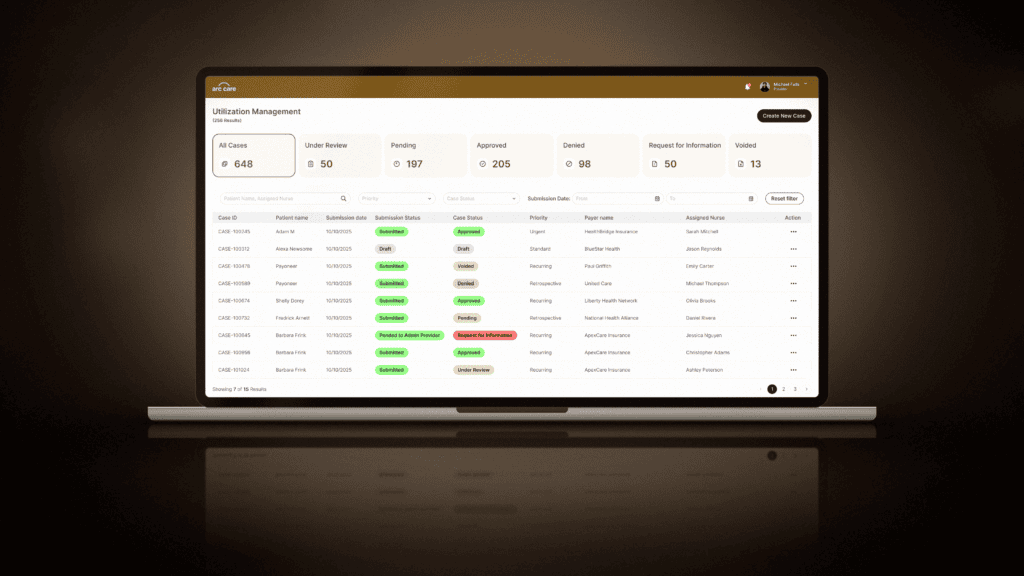
Automated Case Intake & TAT Assignment: Providers create Urgent, Standard, Retrospective, and Recurring UM cases with case-type-specific TAT logic (24 hours, 72 hours, or 30 days), automatic weekend inclusion/exclusion for inpatient vs. outpatient cases, and built-in duplicate-case detection.
Round-Robin Nurse Assignment: Every submitted case is automatically routed to the next available nurse in strict rotation, with inactive nurses skipped and recurring cases re-assigned to their original nurse whenever possible.
Recurring & Concurrent Case Automation: Recurring UM cases auto-generate on frequency completion with prior-case linkage, while inpatient cases support concurrent review requests tied back to the originating case.
Guardrailed Clinical Review Workflow: Nurses, Triage Nurses, and Medical Directors review cases against CPT/ICD data with confirmation prompts on status changes, mandatory notes on regression transitions, and guideline-based CPT-level decisions (Approved / Denied / Partially Approved).
RFI (Request for Information) Automation: When a nurse flags a case as needing more information, the system auto-extends the TAT, generates a structured RFI letter and checklist, and auto-closes the case if the provider misses the response window.
Auto-Generated Compliance Letters: Approval, denial, RFI, and closure letters are system-generated with mandatory fields pre-populated, cutting manual drafting and keeping documentation consistent and audit-ready.
Member & Intake Management: A dedicated Intake Dashboard lets Nurses and Triage Nurses create, search, and manage primary subscriber and dependent profiles, with insurance-eligibility checks run automatically against service dates.
Claims Staff Round-Robin & Payer Handoff: Approved cases flow to Claims Staff through a threshold-controlled round-robin queue and on to Payers for acknowledgment, closing the loop from clinical decision to reimbursement.
Immutable Audit Logging: Every assignment, reassignment, status change, and overdue trigger is logged, with filterable, exportable audit trails available to Super Admins for compliance review.
Secure Document & Comment Threads: Role-based document uploads (PDF/DOCX/JPG, 50MB cap) and time-boxed, character-limited commenting keep provider-nurse communication structured and auditable.